
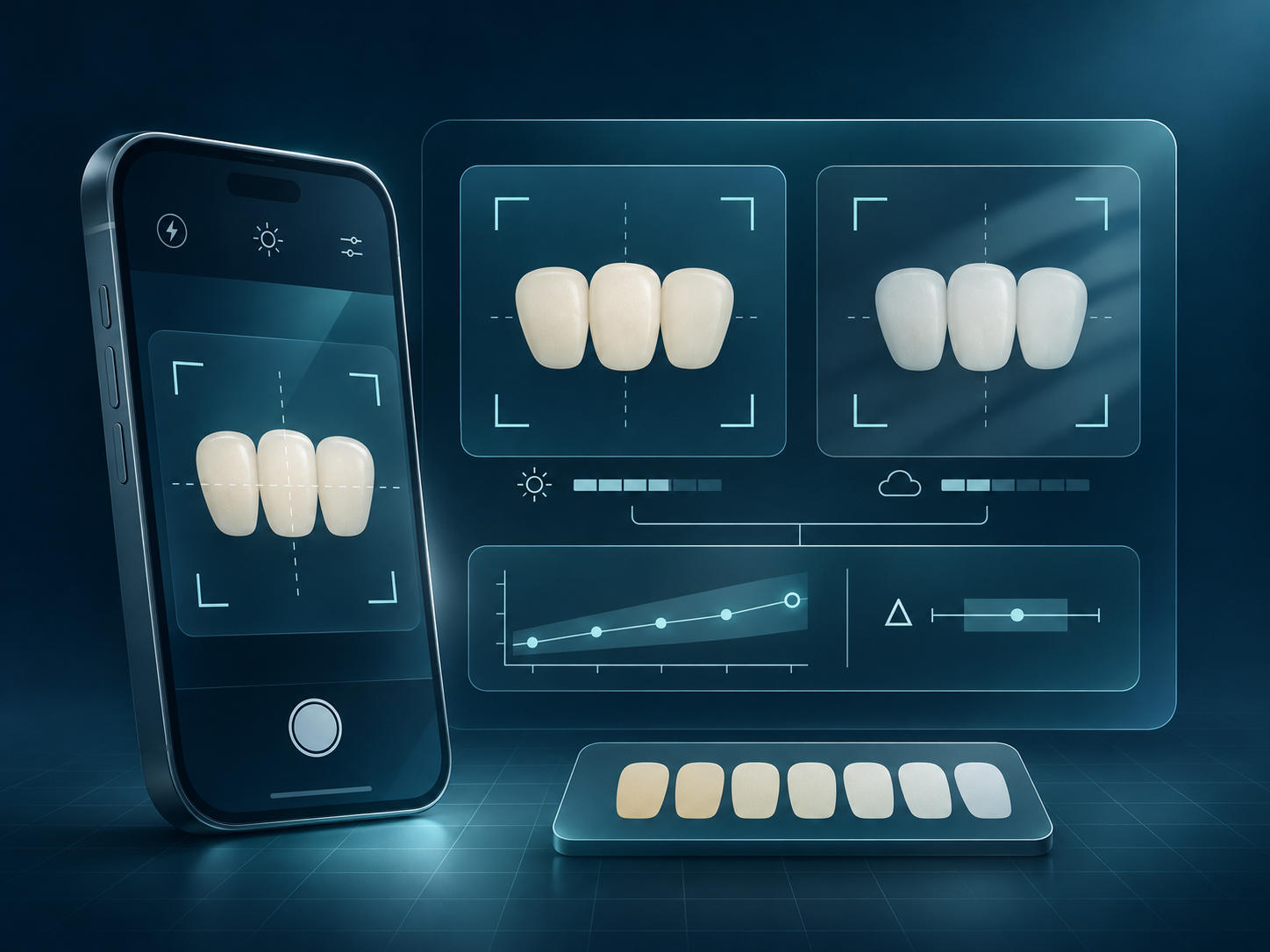
Conceptual illustration of tooth-shade tracking. The depicted shade changes, interface and graph are illustrative, not measured data or a tested product.
A whitening treatment and a progress tracker have different jobs. One is intended to change the appearance of teeth; the other attempts to record that change.
For product developers, the interesting question is what happens when the next scan is too different from the last one to support a meaningful comparison. Should the app still display a score?
Five product approaches
We examined five selected public product descriptions in English, Japanese and Korean. They illustrate different design choices; they are not a representative market sample or a performance ranking.
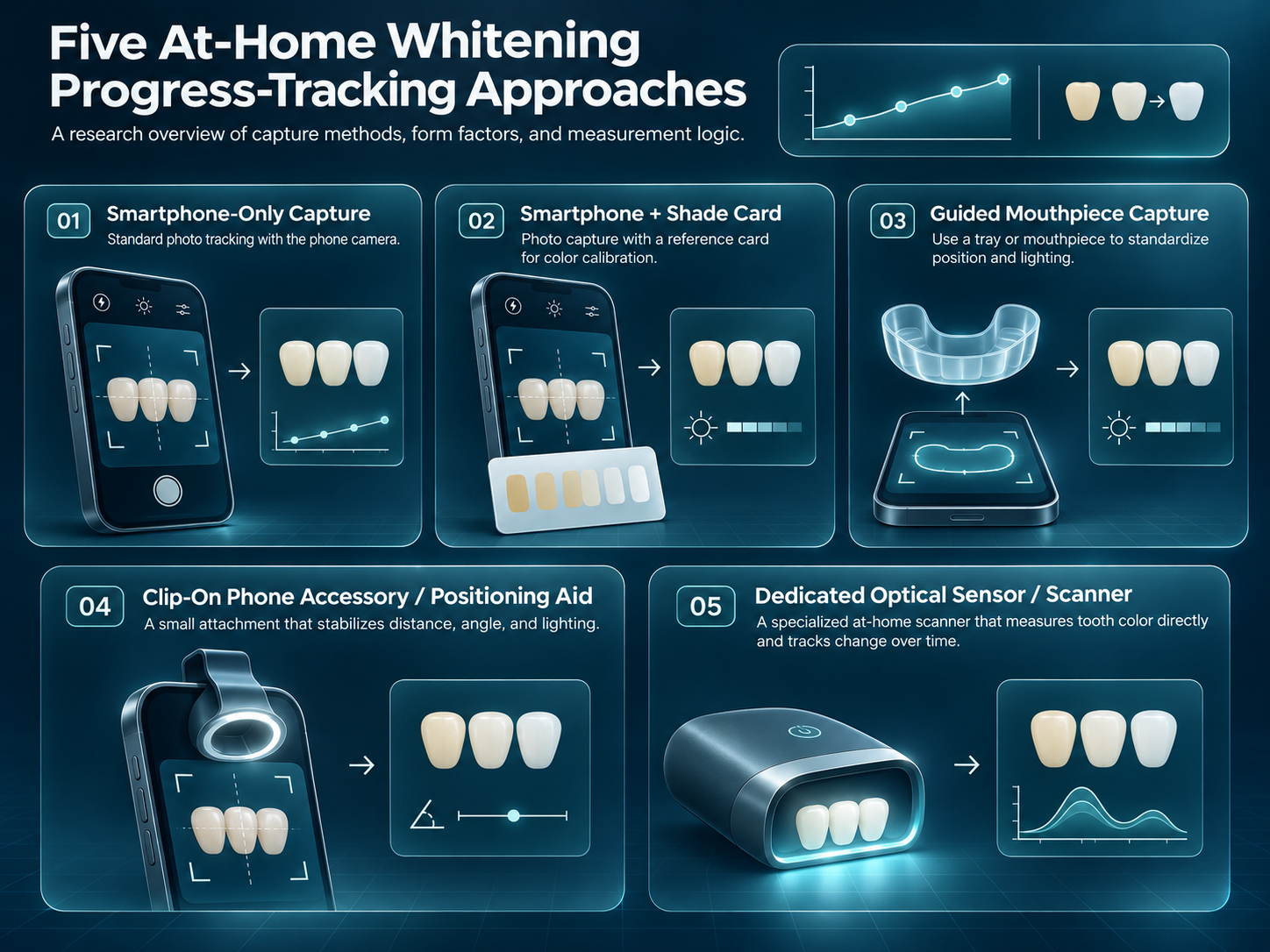
Illustrative overview of possible capture formats. These concepts are not a one-to-one mapping of the five named products, evidence of availability, or proof of calibration or measurement accuracy.
| Product | Developer-described approach | Status of evidence |
|---|---|---|
| Timbre Smile | A light-blocking scope, smartphone camera and scale referenced to the user's first photo. | Google Play listing; scope availability and measurement performance not independently checked. [1] |
| The Bright Lab | Connected whitening device with a colour sensor and session history. | App Store listing; device availability and sensor performance not independently checked. [2] |
| Shade Preview | Visual simulation and a photo log, with an approximate 0–100 score relative to surrounding skin colour. | Japanese App Store listing; score is explicitly presented as an estimate. [3] |
| Enamel | Guided capture using the phone screen as a light source, an internal 16-step index and checks on whether readings can be compared. | Official website, terms and Japanese App Store listing; developer-described behaviour, not independently tested. [4] |
| Chromic | Proposed clinic-linked follow-up using a physical reference card, guided photos and reported sensitivity. | Website demo; the company says patient app downloads and cards are not yet available. [5] |
These approaches overlap. Some products combine simulation, tracking and routine management. An app-store listing or website description does not establish actual hardware sales, sustained use or accuracy.
The problem is older than the current products
A US patent application published in 2019 described a whitening device equipped with tooth-colour sensing. [6] In 2023, researchers at Kogakuin University developed a selfie-based method for relative tooth-shade assessment, using ambient-light sensing and facial landmarks to reduce variation between captures. Their work included successive photographs of seven participants and a separate exploratory assessment involving staining and whitening. The method was relative, and the research workflow used additional image processing outside the capture app. [7]
A 2026 systematic review compared smartphone and DSLR dental shade assessment. A published commentary describes inconsistent findings across eight studies and notes that teeth affected by bleaching were excluded. [8] The review therefore cannot establish the reliability of at-home whitening trackers. Tooth hydration is another consideration: a controlled clinical study reported measurable colour changes during dehydration and rehydration. [9]
Two readings do not always make a trend
A simulated smile, a proprietary shade score and a longitudinal estimate describe different outputs. Comparing readings requires attention to both the capture conditions and what the score represents.
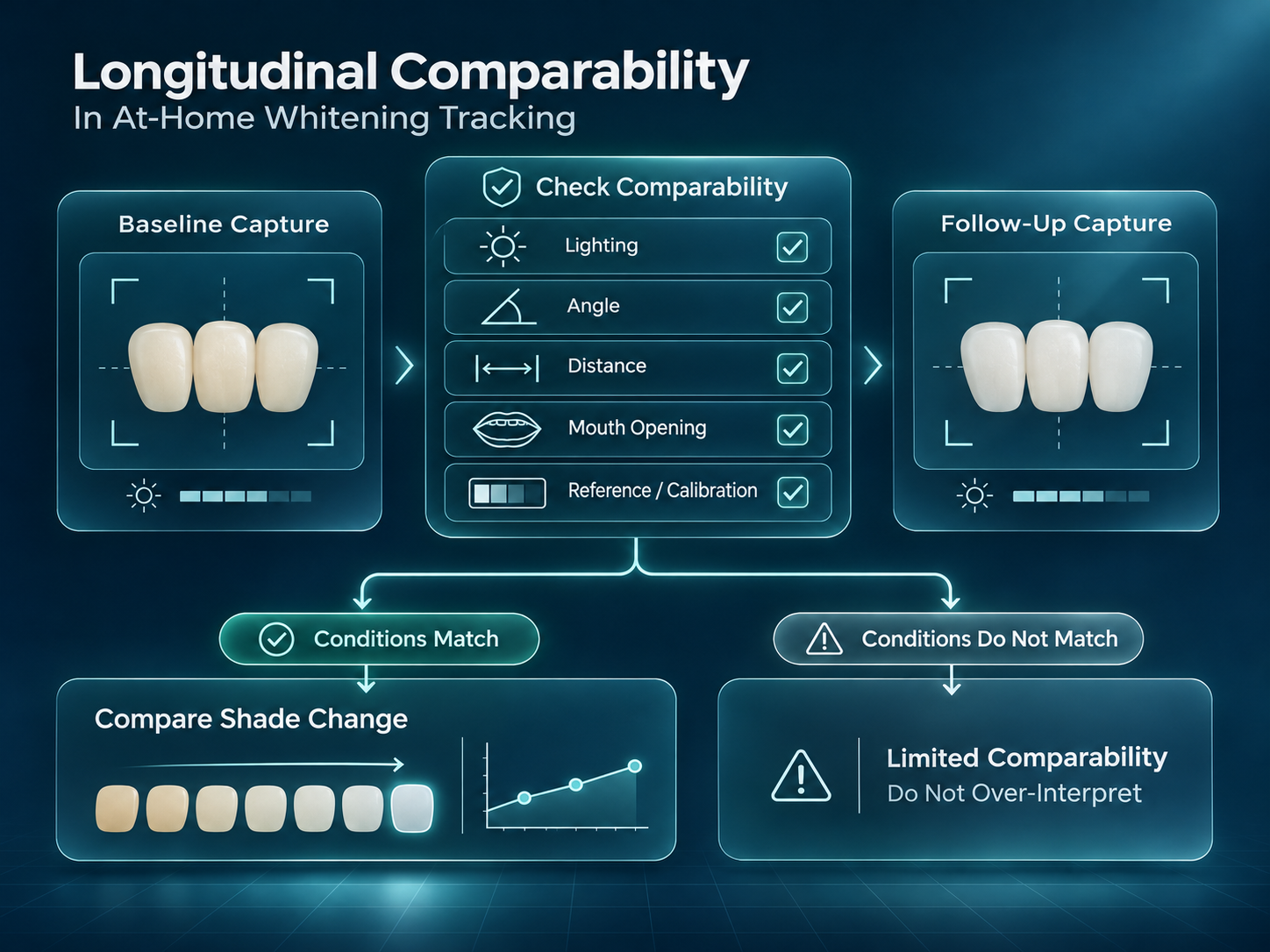
Illustrative comparison framework, not a validated protocol. Matching capture conditions alone cannot establish reliable measurements or treatment efficacy; tooth state, the measurement method and its uncertainty also matter. Charts and shade changes are schematic.
Two details in the product documentation are particularly revealing.
Enamel's terms describe withholding unsuitable scans and keeping earlier readings separate when the measurement method changes. [4] The Bright Lab's November 2026 App Store release notes describe turning its blue treatment light off before each scan. [2]
The first illustrates a design choice about comparability across time and software versions. The second illustrates a manufacturer-reported change to the capture procedure. Neither establishes that one product measures colour more accurately than another.
For the industry, these examples suggest that a progress record deserves scrutiny not just for the number it displays, but for the comparisons the system declines to make.
What we will watch
Future research will track four questions across these approaches:
- How does the developer determine that a new capture is comparable to the baseline?
- Is repeatability reported for unchanged teeth or an appropriate reference, and is the uncertainty of the output disclosed?
- What happens to a user's history when the phone, hardware or measurement method changes?
- Has the system been independently assessed under the intended conditions of use?
A reliable longitudinal record could have value for product development and consumer follow-up. Its commercial usefulness, however, would still need evidence of adoption, sustained use and an effect on relevant decisions. We have not established those outcomes for these examples.